VFD Selector Variable frequency drive sizing
Match your motor and application to the right variable frequency drive. Enter your supply, motor, load and environmental details below — the selector sizes the smallest suitable model across families and flags the additional hardware your application requires, such as line reactors, output filters or braking resistors.
Loading the selector…
Supply
Line voltage Required
Input Phase(s)
Line frequency
{{ phaseConstraintNote }}
Motor nameplate
Motor voltage Required
Running a motor at a much lower voltage than the line voltage is allowed, but increases electrical stress on the motor (insulation, bearings).
Load & duty
Load type
Environment
EMC emission category
Most NEMA 4X, IP66/IP67 models are offered with a disconnect, either built into the drive or as an optional enclosed switch. Expand the result rows below to choose the option.
Control & communications
Still needed: {{ missingFields.join(", ") }}
Your spec
Your spec
Drive & application
Sizing drives against your motor and application…
Matching drives
{{ visibleResults.length }} of {{ results.length }} matching {{ results.length === 1 ? 'drive' : 'drives' }}
No drive matched these inputs. Every candidate considered is listed below with the reason it was ruled out.
No matching drive is in stock.
Also consider the IronHorse ES1. For a simple single-phase application like this one — up to 2 HP on a 230 VAC supply, or 1 HP on 120 VAC — the ES1 is set with trimpots rather than parameters, so there is no software and nothing to configure. It comes panel-mounted or in a washdown NEMA 4X enclosure, and is not included in the results above. Check its limits first: overload is 120% maximum, it must be derated above 60 Hz — the motor’s base speed — and the NEMA 4X models are rated only to 35°C95°F ambient, below the 40°C104°F this selector assumes.
This selector does not derate for higher carrier frequencies. Sizing assumes each drive’s factory-default carrier frequency. If your application requires raising it, you may need to derate or uprate the VFD accordingly.
We also stock zero phase reactors (RF noise filters) for further noise reduction on either side of the drive. This selector does not size these parts, because the sizing depends on motor lead diameter and your chosen carrier frequency.
About variable frequency drives
A variable frequency drive (VFD) controls an AC induction motor’s speed and torque by varying the frequency and voltage delivered to it. A motor started across the line runs at one speed and draws six to eight times its full-load current getting there; a VFD ramps it up smoothly and then holds whatever speed the process actually needs.
On centrifugal pumps and fans, that is where the savings are. Flow falls roughly in proportion to speed while power falls with the cube of it, so a fan slowed to 80% draws around half the power. Throttling a valve or damper spends that energy as pressure drop instead; slowing the motor never generates it in the first place. Controlled acceleration also removes the mechanical shock that wears belts, couplings and gearboxes — and the water hammer that wears pumps — on every across-the-line start.
A VFD is the right choice when the process needs continuous speed or torque control while running. If all you need is smooth starting and stopping, an AC motor soft starter does that job in less panel space and at lower cost.
AutomationDirect stocks AC drives in four classes: micro drives for simple single-motor duty, general purpose drives for most pump, fan and conveyor applications, high-performance drives where closed-loop torque or positioning is required, and washdown (NEMA 4X) drives for food, beverage and other wet environments. This selector sizes across them from your motor nameplate and application, and flags the supporting hardware an installation needs — line reactors and output filters, braking units and resistors, EMI filters, and communication modules.
VFD sizing questions
Which VFD families does this selector cover?
Thirteen families across the four classes AutomationDirect stocks, in every voltage and frame.
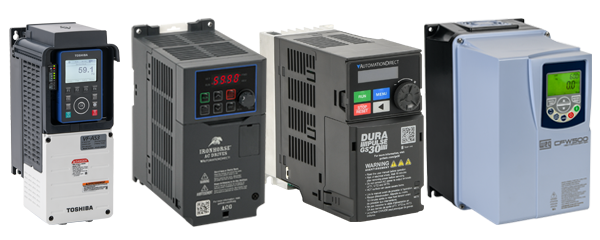
Micro VFDs — DURApulse GS10, IronHorse ACM, WEG CFW100. Small single-motor duty, often DIN rail mounted, with single-phase input available.
General purpose VFDs — DURApulse GS20, IronHorse ACG, WEG CFW300, WEG CFW320. Pumps, fans, conveyors and mixers, the bulk of industrial duty.
High-performance VFDs — DURApulse GS30, DURApulse GS4, Toshiba AS3, WEG CFW500. Closed-loop vector, torque control and positioning, higher horsepower.
Washdown (NEMA 4X) VFDs — DURApulse GS20X, IronHorse ACN, WEG CFW500. Food, beverage and other wet or corrosive environments, mounted outside the panel.
It also picks the supporting hardware from the same inputs: line reactors and output filters, EMI filters, braking units and resistors, and communication and I/O modules.
What size VFD do I need for my motor?
Size the drive on the motor’s nameplate full-load amps, not on its horsepower. Two motors of the same horsepower can draw different current, and the drive’s rating is a current rating. Enter horsepower or kilowatts if that is all you have and the selector converts it through the published motor amp table, but the nameplate is the authoritative number. Then add the headroom the machine actually needs: the worst-case overload it has to ride through, and for how long.
Can I run a three-phase motor from single-phase power?
Yes. The drive rectifies the incoming supply to DC and synthesises its own three-phase output, so a 120 or 240 VAC single-phase supply can run a three-phase motor. What matters is that the drive accepts single-phase input at that voltage and still delivers the output current the motor needs; some families are rated for it and some are not, and the ones that are often carry a lower output rating on single-phase input.
Why do ambient temperature and altitude change which drive I need?
Both reduce the current the same hardware can carry. A drive’s continuous rating assumes an ambient limit, commonly 40°C; above that it must be derated. Thinner air at altitude both cools less and insulates less, so the same derating applies above roughly 1000 m. Enough derating pushes the selection up a frame size, which is why a drive that looks big enough on paper can be the wrong answer in a hot cabinet.
When do I need an output filter or a line reactor?
An output filter goes on long motor lead runs. Past a threshold that depends on the drive, the switching edges reflect back at the motor windings and the voltage adds up, stressing the insulation; a filter slows the edges down. A line reactor sits on the input, adding impedance that limits harmonic current and protects the drive from a stiff supply or a nearby capacitor bank. The selector flags whichever your lead length, supply and emission category require.
Do I need a braking resistor?
Only if the load drives the motor rather than the other way round — a hoist coming down, an unwinder, a decline conveyor, or a high-inertia load that has to stop quickly. Most drives can brake to 15 to 20% of motor torque with nothing added. A braking resistor takes that to 125 to 150% depending on the family, because the energy has somewhere to go.
Do I need a VFD or a soft starter?
A VFD if the process needs to run at a speed you choose, or hold torque while running. A soft starter if all you need is to limit inrush current and mechanical shock on starting and stopping — it does that job in less panel space, at lower cost, and runs the motor at line frequency once it is up.