- Barcode / RFID / Vision
- Bulk Wire & Cable
- Cables (Terminated)
- Circuit Protection / Fuses / Disconnects
- Communications
- Drives & Soft Starters
- Enclosure Thermal Management & Lights
- Enclosures & Racks
- Field I/O
- HMI (Human Machine Interface)
- Hydraulic Components
- Motion Control
- Motor Controls
- Motors
- Pneumatic Components
- Power Products (Electrical)
- Power Transmission (Mechanical)
- Process Control & Measurement
- Programmable Controllers
- Pushbuttons / Switches / Indicators
- Relays / Timers
- Safety
- Sensors / Encoders
- Stacklights
- Structural Frames / Rails
- Tools & Test Equipment
- Valves
- Water (Potable) Components
- Wire & Cable Management
- Wire & Cable Termination
- Retired Products
Configuration Utilities
- PLC Family Selector
- P1000 PLC Systems
- P2000 PLC Systems
- P3000 PLC Systems
- ProductivityCODESYS
- CLICK PLC Systems
- Do-more® BRX PLC Systems
- LS-Electric® XGB PLC Systems
- Productivity®Open Systems
- Datalogic® Safety Light Curtains
- LS-Electric® Servo Systems
- Nitra® Pneumatic Grippers
- Object Detection (Sensors)
- PAL Controller Configurator
- Precision Gearbox Selector
- Protos X® Field I/O
- Pyrometers Selector
- Quadritalia® Modular Enclosures
- Soft Starters
- Stepper System Selector
- SureFrame T-slot Extrusion
- SureMotion® XYZ Gantry
- SureServo2® System Selector
- SureStep® Linear Actuators
- Timing Belts & Pulleys
- Werma® Stacklights
- ZIPLinks

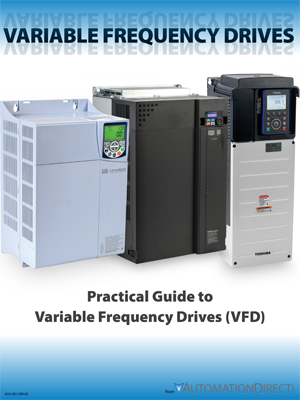
Variable Frequency Drives eBook
Practical Guide to Variable Frequency Drives for Industrial Applications
This eBook is designed for engineers, designers, and maintenance professionals who want a clear, practical understanding of AC motor control using variable frequency drives (VFDs). It explains how electric motors are controlled, when VFDs are the right solution, and how to properly select, apply, and configure drives for real-world industrial applications.
Get the eBook
Fill out the form below.
Thank you for completing this form!
Your eBook should begin downloading in 5 seconds.
If
not, click
here to download this eBook.
Did you know we also
have:
Or, visit our online store for tens of thousands of value priced industrial control products.
- Free 2-Day Shipping $49 and over
- Free downloadable software and manuals for most products
- Free technical support
- 45-day money-back guarantee on almost everything we sell
- In-stock inventory: Order Today, it Ships Today
It all adds up to the #1 Value in Automation.
You have successfully entered the video contest.
You have successfully entered the wera tool giveaway.
You have successfully signed up for the AutomationDirect Newsletter.
You have successfully signed up to receive (a) free..
- {{item}}
You have successfully signed up for the pneumatic chart giveaway.
Please correct the following:
- {{problem}}
There appears to have been an error. Please try submitting again.
{{recheckBoxMessage}}
AutomationDirect is solely responsible for this contest.
This contest is FREE to enter.
No purchase necessary.
This contest is for residents of the United States and Canada only.
18 Years old and older.
One entry per person.
*Only valid in the U.S. and while supplies last.
Variable Frequency Drives eBook
Practical Guide to Variable Frequency Drives for Industrial Applications
This eBook is designed for engineers, designers, and maintenance professionals who want a clear, practical understanding of AC motor control using variable frequency drives (VFDs). It explains how electric motors are controlled, when VFDs are the right solution, and how to properly select, apply, and configure drives for real-world industrial applications.
AutomationDirect's Practical Guide to Variable Frequency Drives (VFDs) is a practical resource for learning how to select and apply AC motor control solutions for industrial equipment. It covers core AC motor control concepts, where VFDs fit compared to starters and soft starters, and the fundamentals of how drives control speed and torque. The guide also digs into real-world VFD details like load types (constant torque vs variable torque), sizing factors, drive classes, control modes (V/Hz, sensorless vector, closed-loop vector, and torque control), and options for braking, feedback, multi-motor configurations, and industrial communications. It also highlights common design and application mistakes to help improve reliability, reduce nuisance faults, and avoid rework during commissioning. If you are specifying, configuring, or troubleshooting VFD applications, this is a strong starting point that stays focused on practical decisions and common pitfalls.
What's Inside:
- Chapter 1: AC Motor Control Introduction - motor basics, the evolution of AC vs DC motor control, and why VFDs are widely used for industrial applications.
- Chapter 2: AC Motor Control Basics - common control methods (across-the-line starters, soft starters, and VFDs) plus guidance on choosing the right approach.
- Chapter 3: VFD Details - load characteristics (CT vs VT), electrical and environmental considerations, drive classes, control modes, torque control, multi-motor strategies, dynamic braking, feedback devices, and communications (hardwired I/O, PTO, serial, and Ethernet protocols).
- Chapter 4: Common Design and Application Errors - avoidable mistakes like improper sizing, poor cooling/ventilation, missing braking, communications noise, grounding issues, line voltage problems, and poor PID tuning.
- Chapter 5: VFD Selection - selection guidance and links to resources to help choose the right drives and supporting components.